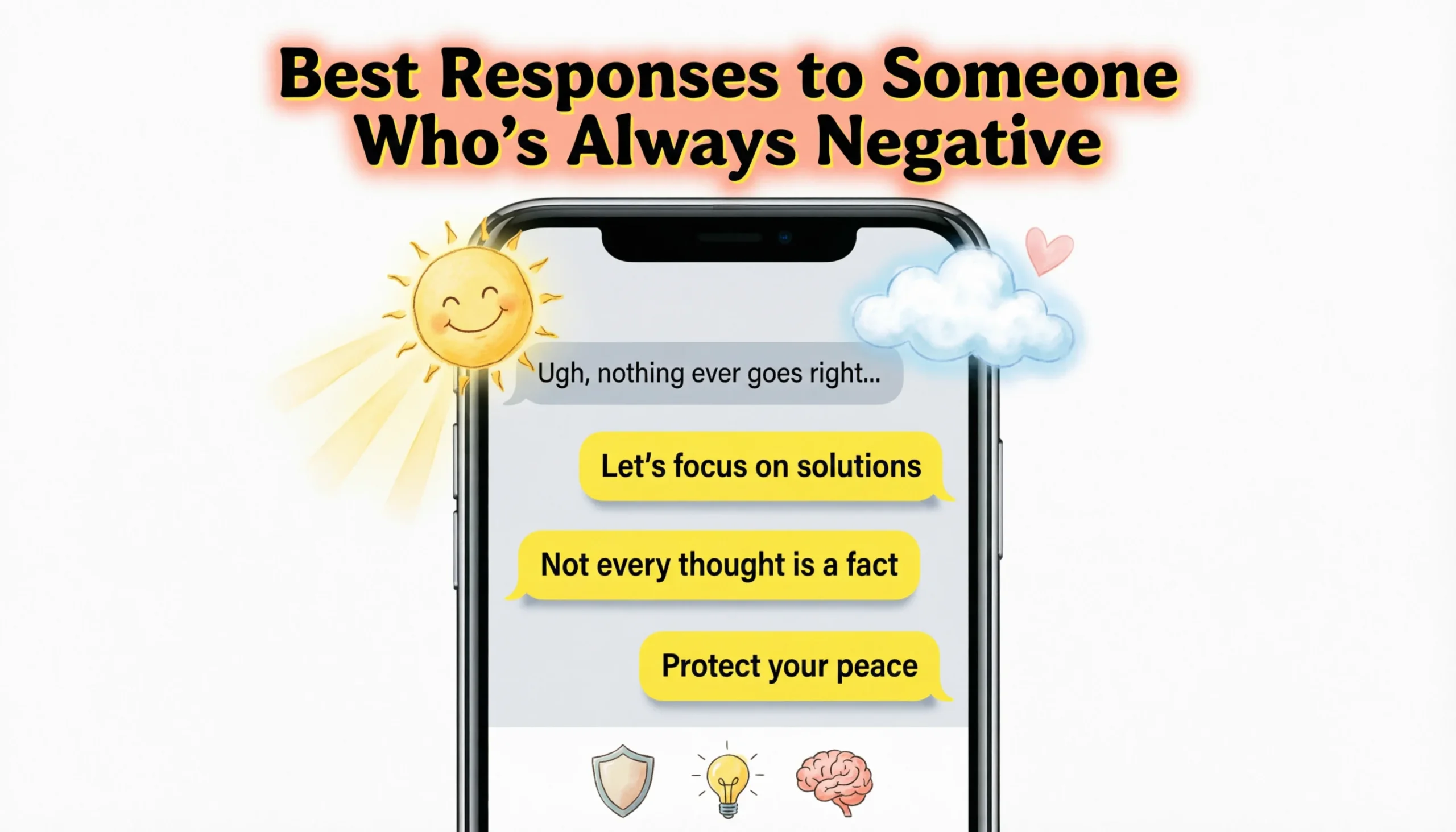
Quick Answer: The best responses to someone who’s always negative depend on your relationship, their attitude, and how much energy you want to give the conversation. You can use humor to lighten the mood, a clever comeback to make your point, or a polite boundary to protect your peace.
Top responses: “Let’s try looking at the bright side,” “You make optimism work overtime,” “Not every situation needs a negative spin,” “I’m choosing a more positive mindset,” “We can talk when we’re ready to focus on solutions.”
Knowing the best responses to someone who’s always negative can help you handle these moments without getting pulled into unnecessary arguments. Sometimes, a funny comeback is enough to lighten the mood. Other times, a calm reply or a firm boundary gets your point across without making things awkward.
The trick is knowing when to joke, when to offer a different perspective, and when to stop engaging altogether. After all, you can care about someone without letting their negativity drain your energy. Whether you need a witty comeback, a polite response, or a confident way to protect your peace, these ready-to-use replies will help you handle the situation with humor, kindness, and confidence.
1. Funny Responses to Someone Who’s Always Negative
Sometimes, a little humor can make the point without turning the conversation into a debate. These funny replies work best with friends and people who appreciate playful teasing.
- Did you wake up on the wrong side of the planet?
Example: When your friend starts complaining before the day has even begun.
Meaning: You’re playfully pointing out their unusually negative mood. - Your glass isn’t half empty; you threw the other half away.
Example: When someone dismisses every good thing about a situation.
Meaning: You’re joking about their habit of overlooking the positives. - You could find a problem in a rainbow.
Example: When someone criticizes even something beautiful or exciting.
Meaning: You’re highlighting their tendency to focus on flaws. - Who hired you as the manager of bad news?
Example: When your friend keeps predicting the worst possible outcome.
Meaning: You’re teasing them for always expecting trouble. - Your inner pessimist deserves employee of the month.
Example: When someone finds something wrong with every suggestion.
Meaning: You’re humorously acknowledging their consistent negativity. - Can we get five minutes without a plot twist?
Example: When a simple conversation becomes a list of problems.
Meaning: You’re asking for a short break from the negativity. - Even Monday thinks you’re being a little dramatic.
Example: When someone complains about everything going wrong.
Meaning: You’re using a familiar joke to lighten the mood. - You bring the rain forecast to every picnic.
Example: When someone ruins exciting plans with endless warnings.
Meaning: You’re pointing out their habit of anticipating disappointment. - Is your default setting set to negative?
Example: When your friend immediately rejects every new idea.
Meaning: You’re joking about their automatic pessimistic reactions. - Somewhere, an optimist is trying to balance your energy.
Example: When someone turns a small inconvenience into a major problem.
Meaning: You’re playfully contrasting their attitude with a more positive outlook. - You make a rainy day sound like the apocalypse.
Example: When someone exaggerates an ordinary setback.
Meaning: You’re suggesting their reaction is bigger than the situation requires. - Let’s reboot that attitude and try again.
Example: When a friend keeps bringing down the mood during a casual hangout.
Meaning: You’re encouraging a playful reset without starting an argument.
2. Clever Responses to Someone Who’s Always Negative
Clever replies make your point without being unnecessarily rude. Use these when you want someone to reconsider their perspective.
- Looking for problems is easy; finding solutions takes effort.
Example: When someone repeatedly identifies issues but refuses to help.
Meaning: You’re encouraging them to contribute something constructive. - A negative prediction isn’t the same as a fact.
Example: When someone insists that your plans are guaranteed to fail.
Meaning: You’re reminding them that assumptions don’t determine outcomes. - What if we focused on what we can actually change?
Example: When a discussion gets stuck on everything outside your control.
Meaning: You’re redirecting attention toward practical solutions. - Not every possibility deserves our worst-case scenario.
Example: When someone imagines disaster before anything has happened.
Meaning: You’re challenging unnecessary pessimism. - Your perspective is one possibility, not the only possibility.
Example: When someone treats their negative opinion as unquestionable truth.
Meaning: You’re making room for different interpretations. - A setback can be information, not a final verdict.
Example: When someone assumes one mistake means the entire plan has failed.
Meaning: You’re encouraging a more balanced response to difficulties. - Let’s separate what we know from what we’re assuming.
Example: When someone makes negative predictions without evidence.
Meaning: You’re bringing the conversation back to facts. - Being realistic also means acknowledging what could go right.
Example: When someone calls every hopeful idea unrealistic.
Meaning: You’re reminding them that realism includes potential benefits. - We don’t have to agree with every negative thought.
Example: When a friend repeatedly insists that everything is hopeless.
Meaning: You’re showing that thoughts can be questioned rather than accepted automatically. - Criticism is more useful when it comes with a possible solution.
Example: When a coworker points out flaws without offering alternatives.
Meaning: You’re encouraging constructive feedback instead of constant complaints. - Let’s give the situation a chance before writing its ending.
Example: When someone predicts failure before you have tried something.
Meaning: You’re encouraging patience and an open mind. - A different perspective might reveal an option we haven’t considered.
Example: When a discussion has become focused entirely on the downsides.
Meaning: You’re inviting a more balanced approach.
3. Polite Responses to Someone Who’s Always Negative
When you want to preserve a relationship, polite replies can acknowledge someone’s concerns without agreeing with their negativity.
- I understand your concerns, but I’d like to consider the positives too.
Example: When a relative questions a decision you’re excited about.
Meaning: You’re respecting their opinion while offering another perspective. - That’s one way to look at it; I see some possibilities as well.
Example: When a friend shares a pessimistic opinion about your plans.
Meaning: You’re disagreeing gently without dismissing their viewpoint. - Let’s try to keep an open mind about this.
Example: When someone rejects a new idea before hearing the details.
Meaning: You’re encouraging them to consider alternatives. - I appreciate your concern, but I’m comfortable exploring this option.
Example: When someone repeatedly warns you against a personal decision.
Meaning: You’re acknowledging their concern while expressing confidence. - I hear what you’re saying, and I’d like to look at the other side too.
Example: When a conversation focuses only on possible disadvantages.
Meaning: You’re asking for a more balanced discussion. - Maybe we can approach this with a little more optimism.
Example: When a friend keeps expecting a disappointing outcome.
Meaning: You’re gently encouraging a more hopeful attitude. - I know things aren’t perfect, but there are some good things here too.
Example: When someone overlooks the progress you’ve made.
Meaning: You’re recognizing difficulties without ignoring the positives. - Let’s not rule it out just yet.
Example: When someone dismisses an opportunity before exploring it.
Meaning: You’re suggesting that the decision deserves more consideration. - I respect your opinion, even though I see it differently.
Example: When you want to disagree without damaging a friendship.
Meaning: You’re expressing disagreement respectfully. - We might find a better answer if we look at both sides.
Example: When a discussion becomes one-sided and discouraging.
Meaning: You’re inviting a more balanced conversation. - I understand why you’re worried, but let’s see how things develop.
Example: When someone is anxious about an upcoming event.
Meaning: You’re acknowledging uncertainty without assuming the worst. - I’d rather focus on what we can do next.
Example: When a conversation keeps circling around everything that went wrong.
Meaning: You’re politely steering the discussion toward action.
4. Sarcastic Responses to Someone Who’s Always Negative
A little sarcasm can be funny when there’s mutual trust. Keep these replies playful rather than personal, especially if the other person is already upset.
- Thank goodness you’re here to lower everyone’s expectations.
Example: When a friend dismisses an exciting plan immediately.
Meaning: You’re sarcastically highlighting their pessimistic attitude. - Have you considered a career in predicting disappointments?
Example: When someone confidently expects everything to go wrong.
Meaning: You’re teasing them about their constant negative predictions. - I see the optimism department is closed today.
Example: When someone refuses to acknowledge a single positive detail.
Meaning: You’re joking about their lack of enthusiasm. - Well, that was a refreshing little rain cloud.
Example: When someone interrupts good news with complaints.
Meaning: You’re sarcastically noting how they changed the mood. - Did the bright side personally offend you?
Example: When someone refuses to see any benefits in a situation.
Meaning: You’re playfully questioning their resistance to positive thinking. - And there goes our daily dose of encouragement.
Example: When a friend responds negatively to your latest achievement.
Meaning: You’re pointing out their discouraging response with humor. - You really know how to turn a win into a warning.
Example: When someone finds risks in something that went well.
Meaning: You’re highlighting their tendency to focus on potential problems. - I was wondering when the pessimism report would arrive.
Example: When a familiar person begins listing everything that could fail.
Meaning: You’re joking about their predictable negativity. - Should we celebrate first or schedule the disappointment?
Example: When someone assumes a promising opportunity will end badly.
Meaning: You’re teasing them for anticipating failure too soon. - Your enthusiasm is absolutely taking the scenic route.
Example: When someone struggles to show excitement about good news.
Meaning: You’re making a lighthearted comment about their lack of positivity. - That idea hasn’t even started, and you’ve already buried it.
Example: When someone rejects a plan before giving it a chance.
Meaning: You’re calling attention to their premature judgment. - I’ll alert the sunshine department that we’re having another emergency.
Example: When someone makes a minor inconvenience sound disastrous.
Meaning: You’re using exaggeration to make their reaction seem less serious.
5. Firm Responses to Someone Who’s Always Negative
Sometimes, humor doesn’t work. If someone’s negativity repeatedly affects your mood or confidence, a direct response may be more helpful.
- I don’t want every conversation to focus on what’s wrong.
Example: When someone turns every discussion into a complaint session.
Meaning: You’re clearly expressing what you want to change. - I’m open to feedback, but constant criticism isn’t helpful.
Example: When someone repeatedly criticizes your decisions.
Meaning: You’re distinguishing constructive feedback from ongoing negativity. - Please don’t dismiss my plans before hearing me out.
Example: When someone interrupts your ideas with immediate objections.
Meaning: You’re asking to be treated with consideration. - I can listen to your concerns without agreeing with your conclusions.
Example: When someone expects you to share their pessimistic outlook.
Meaning: You’re establishing that listening doesn’t mean agreeing. - I need this conversation to be more constructive.
Example: When a discussion keeps returning to the same complaints.
Meaning: You’re setting a clear expectation for the conversation. - I’m not going to argue about every possible thing that could go wrong.
Example: When someone keeps inventing new reasons to oppose your plans.
Meaning: You’re choosing not to participate in an exhausting debate. - You can disagree with me without putting down my choices.
Example: When someone criticizes your decisions in a personal way.
Meaning: You’re asking for respectful disagreement. - I’ve heard your concerns, and I’m making my own decision.
Example: When someone continues trying to change your mind after you’ve listened.
Meaning: You’re asserting your independence. - I won’t keep defending myself against assumptions.
Example: When someone repeatedly imagines bad intentions behind your actions.
Meaning: You’re refusing to engage in an unfair discussion. - Let’s pause if we’re only making each other frustrated.
Example: When a conversation becomes repetitive and tense.
Meaning: You’re suggesting a break before things escalate. - I care about you, but I can’t solve every problem for you.
Example: When someone expects you to manage their repeated worries.
Meaning: You’re showing care while recognizing your own limits. - I’m happy to talk when we’re both ready to listen.
Example: When someone refuses to consider anything beyond their own viewpoint.
Meaning: You’re setting a respectful condition for continuing the conversation.
6. Professional Responses to Someone Who’s Always Negative
At work, the goal is to keep conversations productive without sounding defensive. These replies are useful in meetings, emails, and workplace discussions.
- Let’s focus on the next steps we can take.
Example: When a meeting becomes stuck on project difficulties.
Meaning: You’re redirecting the team toward practical action. - Could you suggest an alternative approach?
Example: When a colleague repeatedly rejects your proposals.
Meaning: You’re inviting constructive input instead of further criticism. - Let’s evaluate the risks alongside the potential benefits.
Example: When a coworker focuses exclusively on possible downsides.
Meaning: You’re encouraging a balanced assessment. - I appreciate the feedback; let’s discuss possible solutions.
Example: When someone raises several concerns during a project review.
Meaning: You’re acknowledging their input and encouraging progress. - We may have different perspectives, so let’s review the available facts.
Example: When a professional disagreement becomes overly negative.
Meaning: You’re grounding the discussion in evidence. - What would need to change for this approach to work?
Example: When a team member says a plan cannot succeed.
Meaning: You’re turning an objection into a practical question. - Let’s identify the main obstacle and address it directly.
Example: When coworkers keep listing problems without prioritizing them.
Meaning: You’re bringing focus to the most important issue. - I’d welcome specific feedback that helps us improve the outcome.
Example: When criticism is vague or repeated without useful details.
Meaning: You’re asking for actionable suggestions. - We should distinguish confirmed risks from potential concerns.
Example: When a discussion includes several unverified assumptions.
Meaning: You’re encouraging clearer professional reasoning. - Let’s keep the discussion focused on what we can influence.
Example: When a team spends too much time discussing uncontrollable factors.
Meaning: You’re steering attention toward achievable progress. - I understand the concern; what would you recommend instead?
Example: When a colleague rejects a proposed solution.
Meaning: You’re encouraging them to contribute a workable alternative. - Let’s revisit this after we’ve reviewed the options.
Example: When a meeting becomes repetitive and unproductive.
Meaning: You’re suggesting a structured way to move forward.
7. Chill and Casual Responses to Someone Who’s Always Negative
Not every negative comment needs a serious response. These relaxed replies are ideal for everyday chats with friends, siblings, and people you know well.
- Let’s not stress about it before it happens.
Example: When a friend worries about an event that’s still days away.
Meaning: You’re encouraging them to take things one step at a time. - We’ll figure it out when we get there.
Example: When someone worries about every possible detail of a plan.
Meaning: You’re expressing confidence in handling problems as they arise. - Okay, but what’s the good news?
Example: When someone shares several complaints in a row.
Meaning: You’re casually inviting them to notice something positive. - Let’s give it a fair shot first.
Example: When a friend rejects an activity before trying it.
Meaning: You’re encouraging them to stay open-minded. - One thing at a time, my friend.
Example: When someone becomes overwhelmed by multiple worries.
Meaning: You’re encouraging a calmer, more manageable approach. - It might turn out better than we think.
Example: When someone expects a disappointing result without knowing the outcome.
Meaning: You’re offering gentle optimism. - Let’s not borrow trouble from tomorrow.
Example: When a friend worries about problems that haven’t happened.
Meaning: You’re reminding them to focus on the present. - We haven’t reached the ending yet.
Example: When someone assumes a difficult situation cannot improve.
Meaning: You’re reminding them that the outcome remains uncertain. - A little perspective might help here.
Example: When someone reacts strongly to a relatively small inconvenience.
Meaning: You’re suggesting they reconsider the situation calmly. - Let’s take a breath and reset.
Example: When a conversation becomes tense because of constant complaining.
Meaning: You’re encouraging everyone to relax before continuing. - Not everything is a problem to solve right now.
Example: When someone feels the need to analyze every minor issue.
Meaning: You’re encouraging them to let some things go. - Let’s save some energy for the good stuff.
Example: When a friend spends the whole hangout discussing what’s wrong.
Meaning: You’re encouraging them to make room for enjoyable moments.
8. Supportive Responses to Someone Who’s Always Negative
Sometimes negativity comes from stress, disappointment, or fear. A supportive response can show understanding without requiring you to agree with every negative thought.
- What’s been weighing on you lately?
Example: When someone who usually seems fine has become unusually pessimistic.
Meaning: You’re inviting them to share what’s bothering them. - You don’t have to figure everything out today.
Example: When a friend feels overwhelmed by several problems.
Meaning: You’re reassuring them that they can take their time. - I’m here to listen, even if we don’t have all the answers.
Example: When someone needs to talk through a difficult situation.
Meaning: You’re offering support without pretending to have an instant solution. - That sounds difficult; what would help you most right now?
Example: When someone repeatedly discusses a stressful experience.
Meaning: You’re acknowledging their feelings and asking what kind of support they need. - You’ve handled difficult things before, and you can take this one step at a time.
Example: When someone doubts their ability to manage a challenge.
Meaning: You’re reminding them of their resilience without promising an outcome. - It’s okay to feel worried, but you don’t have to face it alone.
Example: When a loved one is anxious about an uncertain situation.
Meaning: You’re validating their feelings while offering companionship. - Let’s focus on one small thing that might make today easier.
Example: When someone feels overwhelmed by everything going wrong.
Meaning: You’re helping them identify a manageable next step. - I care about what you’re going through.
Example: When a friend thinks their worries are being ignored.
Meaning: You’re communicating genuine concern. - You can tell me what’s wrong without needing to pretend you’re okay.
Example: When someone hides their feelings behind constant complaints.
Meaning: You’re creating space for honest emotional expression. - Maybe we can look at this together from another angle.
Example: When someone feels trapped by a negative interpretation.
Meaning: You’re offering collaboration rather than judgment. - You deserve patience while you’re working through this.
Example: When someone feels guilty about struggling with a difficult period.
Meaning: You’re encouraging self-compassion. - I’m rooting for you, even when things feel uncertain.
Example: When someone doubts their chances of success.
Meaning: You’re expressing encouragement without dismissing their worries.
9. Confident Responses to Someone Who’s Always Negative
When someone constantly questions your choices, confidence helps you stand your ground without turning every disagreement into a competition.
- I believe in my ability to figure this out.
Example: When someone doubts your ability to complete a new project.
Meaning: You’re expressing trust in your own problem-solving skills. - I can consider your opinion without letting it decide for me.
Example: When someone tries to discourage you from pursuing a goal.
Meaning: You’re showing that advice doesn’t control your decisions. - I’m willing to try, even if success isn’t guaranteed.
Example: When someone says an opportunity is too risky to pursue.
Meaning: You’re accepting uncertainty as part of taking action. - I don’t need every outcome to be certain before I begin.
Example: When someone insists you should wait until everything is perfect.
Meaning: You’re expressing confidence in taking reasonable steps despite uncertainty. - I trust myself to learn along the way.
Example: When a friend questions your experience with something new.
Meaning: You’re emphasizing growth and adaptability. - Your doubts don’t have to become my doubts.
Example: When someone repeatedly predicts that you’ll fail.
Meaning: You’re protecting your confidence from another person’s pessimism. - I’ll make room for feedback, not discouragement.
Example: When someone criticizes your plans without offering useful advice.
Meaning: You’re setting a standard for the input you choose to accept. - I can acknowledge the risks and still move forward.
Example: When someone assumes that taking a risk is automatically a mistake.
Meaning: You’re showing that caution and confidence can coexist. - I’m focused on progress, not perfection.
Example: When someone points out every small flaw in your work.
Meaning: You’re prioritizing improvement over unrealistic expectations. - I don’t have to prove every decision to everyone.
Example: When someone keeps demanding explanations for your personal choices.
Meaning: You’re asserting your right to make independent decisions. - I’ll decide what makes sense for my situation.
Example: When someone insists their pessimistic advice is the only sensible option.
Meaning: You’re taking responsibility for your own choices. - I can hear the concerns without losing sight of my goal.
Example: When someone tries to distract you from an important ambition.
Meaning: You’re staying focused while remaining open to useful feedback.
10. Sweet Responses to Someone Who’s Always Negative
Sweet replies can soften the mood, particularly when you care about the person and want to encourage them rather than embarrass them.
- I hope something good surprises you today.
Example: When a friend starts the morning expecting a bad day.
Meaning: You’re offering a gentle wish for a better experience. - There’s still a little sunshine hiding in this situation.
Example: When someone struggles to see anything positive about a setback.
Meaning: You’re encouraging them to look for small moments of hope. - Let’s find one little thing worth smiling about.
Example: When a loved one feels discouraged by everyday problems.
Meaning: You’re inviting them to notice a small positive detail. - You deserve good moments, too.
Example: When someone talks as if disappointment is all they can expect.
Meaning: You’re reminding them that positive experiences matter. - I hope you give yourself the same kindness you give others.
Example: When someone is harshly critical of themselves.
Meaning: You’re encouraging self-kindness and a more balanced outlook. - Bad days don’t cancel out all the good ones.
Example: When a friend treats one difficult day as proof that everything is wrong.
Meaning: You’re reminding them not to overlook positive experiences. - Let’s be gentle with ourselves while we work things out.
Example: When someone feels frustrated by mistakes or setbacks.
Meaning: You’re encouraging patience and understanding. - There’s more to this story than the difficult part.
Example: When someone focuses only on one disappointing moment.
Meaning: You’re inviting them to consider the bigger picture. - I hope you find a reason to feel hopeful again.
Example: When a loved one feels discouraged about the future.
Meaning: You’re expressing care and wishing them renewed hope. - You don’t have to carry every worry at once.
Example: When someone feels weighed down by several concerns.
Meaning: You’re reminding them to take things gradually. - Let’s celebrate the little wins, too.
Example: When someone ignores small improvements because the larger goal remains unfinished.
Meaning: You’re encouraging appreciation for gradual progress. - I’m glad you’re here, even on your difficult days.
Example: When a friend worries that their struggles make them difficult to be around.
Meaning: You’re reassuring them that their worth isn’t defined by their mood.
11. Emotional Responses to Someone Who’s Always Negative
If someone’s negativity affects your relationship, an honest response can communicate your feelings without attacking their character.
- Sometimes, your words make it hard for me to share good news with you.
Example: When a loved one repeatedly responds to your achievements with criticism.
Meaning: You’re explaining how their reactions affect your willingness to open up. - I miss being able to enjoy things together without expecting criticism.
Example: When a friendship has become dominated by complaints.
Meaning: You’re expressing a desire to reconnect more positively. - I want to support you, but I also need our conversations to feel balanced.
Example: When every interaction revolves around one person’s problems.
Meaning: You’re asking for mutual emotional consideration. - It hurts when my excitement is immediately met with reasons to worry.
Example: When someone repeatedly dampens your enthusiasm about personal goals.
Meaning: You’re sharing the emotional impact of their reactions. - I care about you too much to pretend this pattern doesn’t affect me.
Example: When you need to discuss a recurring issue with a close friend.
Meaning: You’re being honest because the relationship matters to you. - I want us to be able to talk about problems and good things equally.
Example: When a relationship seems to have lost its positive moments.
Meaning: You’re expressing a wish for more balanced communication. - I understand that life is difficult, but I struggle when everything feels hopeless.
Example: When a loved one repeatedly assumes nothing will improve.
Meaning: You’re acknowledging their difficulties while sharing your own emotional limits. - I don’t expect you to be positive all the time; I just want room for hope.
Example: When someone mistakes your request for balance as pressure to be cheerful.
Meaning: You’re clarifying that optimism doesn’t mean denying difficult feelings. - I feel drained when our conversations never move beyond what’s wrong.
Example: When repeated complaint sessions leave you emotionally exhausted.
Meaning: You’re communicating the effect of the pattern on your energy. - I’d love for us to notice the good moments when they happen.
Example: When someone overlooks every positive experience you share.
Meaning: You’re asking to appreciate enjoyable moments together. - I can’t fix everything you’re facing, but I can listen when we both communicate respectfully.
Example: When you want to support a friend without accepting hurtful interactions.
Meaning: You’re offering care while establishing a healthy boundary. - I hope we can find a healthier way to talk through difficult things.
Example: When you want to improve a relationship affected by persistent negativity.
Meaning: You’re expressing hope for more constructive communication.
12. Short and Witty Responses to Someone Who’s Always Negative
When you’re texting or replying in a group chat, a short line often works better than a long explanation.
- Let’s switch perspectives.
Example: When a group chat becomes focused on everything going wrong.
Meaning: You’re suggesting a different way of looking at things. - Where’s the silver lining?
Example: When a friend shares a setback without considering any positives.
Meaning: You’re inviting them to find a hopeful angle. - Solutions over complaints.
Example: When someone repeatedly complains about a fixable problem.
Meaning: You’re encouraging action instead of endless frustration. - Let’s not assume the worst.
Example: When someone predicts failure before receiving any information.
Meaning: You’re asking them to avoid premature conclusions. - A little hope goes a long way.
Example: When someone feels discouraged by an uncertain outcome.
Meaning: You’re encouraging a more hopeful outlook. - Different angle, same situation.
Example: When someone believes there is only one way to interpret a problem.
Meaning: You’re suggesting that perspective can change without changing the facts. - Let’s focus on progress.
Example: When a friend overlooks how far they’ve come.
Meaning: You’re redirecting attention toward improvement. - Not every thought is a prediction.
Example: When someone treats a worrying thought as proof of future failure.
Meaning: You’re separating anxiety from certainty. - One problem, one solution.
Example: When someone lists several worries about a single manageable issue.
Meaning: You’re encouraging a practical, step-by-step approach. - Hope is still an option.
Example: When someone assumes a difficult situation cannot improve.
Meaning: You’re reminding them that a positive outcome remains possible. - Let’s keep it constructive.
Example: When a discussion starts becoming repetitive and unhelpful.
Meaning: You’re encouraging respectful, useful communication. - Less worrying, more trying.
Example: When a friend keeps delaying a reasonable plan because of imagined problems.
Meaning: You’re encouraging action instead of excessive overthinking.
13. Creative Responses to Someone Who’s Always Negative
Creative replies make a conversation more memorable. These work especially well with friends who enjoy wordplay and playful comparisons.
- Your mind keeps writing disaster movies before filming starts.
Example: When a friend predicts every possible failure before taking action.
Meaning: You’re joking about their tendency to imagine negative outcomes. - Let’s give this story a plot twist called ‘Things Worked Out.’
Example: When someone assumes a plan will end badly.
Meaning: You’re encouraging them to consider a better possible outcome. - Your worry department is working overtime again.
Example: When someone analyzes every small detail for potential problems.
Meaning: You’re playfully pointing out their excessive worrying. - Let’s invite possibility into this conversation.
Example: When a discussion has become focused entirely on limitations.
Meaning: You’re encouraging fresh ideas and alternative outcomes. - The clouds are loud today, but the sky is still there.
Example: When someone is having a difficult day and sees no positives.
Meaning: You’re reminding them that temporary problems don’t erase every good thing. - Let’s stop giving imaginary problems starring roles.
Example: When someone spends more time worrying about hypothetical issues than real ones.
Meaning: You’re encouraging them to prioritize what is actually happening. - Not every closed door means the whole building is locked.
Example: When someone assumes one rejection ends every opportunity.
Meaning: You’re encouraging them to look for other possibilities. - Let’s trade the doom playlist for a fresh perspective.
Example: When a friend repeatedly talks about everything that could go wrong.
Meaning: You’re suggesting a change in the emotional tone. - Your inner critic needs a coffee break.
Example: When someone constantly criticizes themselves or their ideas.
Meaning: You’re encouraging them to ease up on their self-judgment. - The future hasn’t sent us its final report yet.
Example: When someone insists they already know how a situation will end.
Meaning: You’re reminding them that the outcome remains unknown. - Let’s leave a little space for a happy accident.
Example: When someone wants every detail to be perfect before beginning.
Meaning: You’re encouraging flexibility and openness to unexpected benefits. - We can edit the plan without deleting the dream.
Example: When a setback makes someone want to abandon an important goal.
Meaning: You’re showing that adjusting an approach doesn’t require giving up.
14. Responses to Someone Who’s Always Negative About Your Success
When someone questions your achievements or discourages your ambitions, choose a response that protects your confidence without turning success into a competition.
- I’m proud of how far I’ve come, and I’m still growing.
Example: When someone minimizes your recent achievement.
Meaning: You’re recognizing your progress without needing their approval. - You don’t have to share my excitement for me to enjoy this moment.
Example: When someone responds coldly to your good news.
Meaning: You’re allowing yourself to celebrate regardless of their reaction. - I’d rather learn by trying than regret never starting.
Example: When someone discourages you from pursuing a new goal.
Meaning: You’re expressing a willingness to take thoughtful action. - I appreciate advice that helps me improve, not comments that make me give up.
Example: When someone repeatedly undermines your confidence.
Meaning: You’re setting a standard for useful feedback. - My progress doesn’t need to make sense to everyone.
Example: When someone questions your personal goals or achievements.
Meaning: You’re accepting that people may have different priorities. - I’m focusing on what I can build, not what others expect me to fail at.
Example: When someone repeatedly predicts that your plans won’t succeed.
Meaning: You’re keeping your attention on your own efforts. - I’m allowed to be excited before I have every answer.
Example: When someone tries to dampen your enthusiasm about a new opportunity.
Meaning: You’re giving yourself permission to enjoy the possibilities. - A little uncertainty doesn’t make my goal less worthwhile.
Example: When someone argues that your plans are too risky or unpredictable.
Meaning: You’re acknowledging uncertainty without abandoning your ambition. - I’d rather receive constructive advice than constant discouragement.
Example: When someone criticizes your decisions without helping you improve.
Meaning: You’re asking for feedback that supports progress. - I’m building confidence through action, not waiting for everyone’s approval.
Example: When someone questions your ability to accomplish something important.
Meaning: You’re emphasizing personal initiative and independence. - You can have your doubts while I do the work.
Example: When someone repeatedly predicts failure despite your preparation.
Meaning: You’re choosing to focus on effort rather than their expectations. - I’ll let the results speak for themselves.
Example: When someone questions your plans before seeing what you can accomplish.
Meaning: You’re choosing to demonstrate your abilities through action.
15. Boundary-Setting Responses to Someone Who’s Always Negative
If the negativity continues despite your efforts, boundaries can help you protect your time and emotional energy. You don’t need to win an argument to step away from one.
- I don’t have the energy for another negative conversation right now.
Example: When you’re already tired and someone starts another extended complaint session.
Meaning: You’re honestly communicating your current limits. - Let’s talk about something else for a while.
Example: When a casual catch-up keeps returning to the same frustrations.
Meaning: You’re redirecting the conversation without rejecting the person. - I’m going to step away if this becomes personal.
Example: When someone’s criticism starts turning into insults.
Meaning: You’re establishing a clear boundary around respectful communication. - I can care about you without agreeing with everything you say.
Example: When someone expects you to support every negative judgment they make.
Meaning: You’re separating emotional support from automatic agreement. - I’ve shared my perspective, so I’m comfortable leaving it there.
Example: When a disagreement keeps repeating without any progress.
Meaning: You’re ending an unproductive debate calmly. - I need our conversations to respect both of our feelings.
Example: When someone expects you to listen but dismisses your concerns.
Meaning: You’re asking for mutual respect and consideration. - I’m happy to help with solutions, but I can’t keep repeating the same discussion.
Example: When someone repeatedly discusses the same problem without considering any next steps.
Meaning: You’re offering support while limiting circular conversations. - I won’t take responsibility for changing your outlook.
Example: When someone expects you to make them feel better every time they’re unhappy.
Meaning: You’re recognizing that their perspective is ultimately theirs to manage. - I need a little distance from conversations that leave me feeling drained.
Example: When repeated interactions are affecting your emotional well-being.
Meaning: You’re communicating a need for space. - Let’s continue this when we can both approach it respectfully.
Example: When a discussion becomes tense or dismissive.
Meaning: You’re setting a condition for a healthier conversation. - I respect your feelings, and I need you to respect my limits too.
Example: When someone treats your boundaries as a lack of care.
Meaning: You’re balancing empathy with self-respect. - I’m choosing to protect my peace rather than argue about this.
Example: When a conversation is going nowhere and affecting your mood.
Meaning: You’re choosing to disengage instead of escalating the disagreement.
FAQs About Responding to Someone Who’s Always Negative
What does it mean when someone is always negative?
It may reflect stress, fear, habit, disappointment, or their way of interpreting situations. You can’t know the reason without asking.
How do you respond to someone who is always negative?
Stay calm, acknowledge valid concerns, encourage solutions, and set boundaries if the negativity becomes draining.
What is a good comeback for a negative person?
Try, “You make optimism work overtime.” It’s playful and works best with someone who enjoys friendly teasing.
How do you respond to a negative person professionally?
Say, “Let’s focus on practical solutions and the options available to us.” It keeps the discussion constructive.
What should you say to someone who always expects the worst?
Try, “Let’s wait until we have the facts before assuming the outcome.” It encourages a more balanced view.
Is humor appropriate when responding to a negative person?
Yes, if you know the person well and they welcome teasing. Use empathy instead when they’re genuinely struggling.
How do you respond when someone is negative about your success?
Say, “I’m proud of my progress, and I’m going to keep working toward my goals.”
How do you set boundaries with a negative person?
Explain what you can offer, what you cannot manage, and when you need to step away.
What if you don’t actually mean a positive response?
Keep it honest and neutral. Try, “I understand your concerns, but I need time to think about this.”
Can a negative person change their attitude?
Change is possible when someone recognizes their patterns and wants to work on them. You cannot force that change.
Conclusion
Dealing with someone who’s always negative doesn’t mean you have to become negative yourself. The right response can lighten the mood, encourage a better perspective, protect your confidence, or make your boundaries clear. Sometimes a funny one-liner is all it takes to move a conversation along. Other times, a calm and honest statement is far more effective.
Remember, you don’t have to fix everyone’s outlook or prove that every situation will work out perfectly. Choose replies that fit the relationship, the moment, and your own comfort level. Save your favorite responses for your next group chat, workplace conversation, or unexpected complaint session. Share this list with a friend who needs a little conversational inspiration, and keep choosing responses that reflect your confidence and kindness.