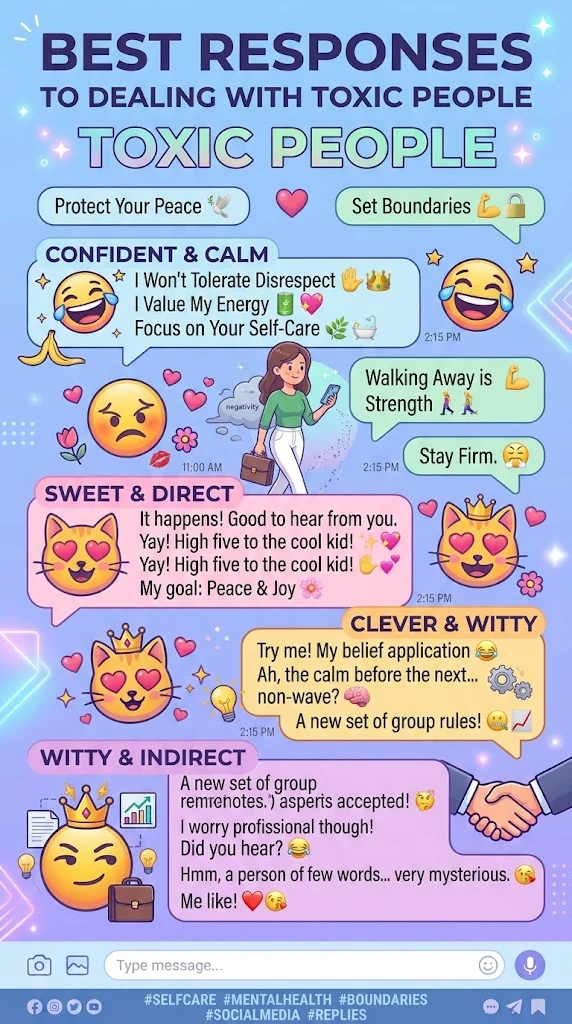
Quick Answer: The best responses to dealing with toxic people are calm, confident, and clear. You don’t have to argue, explain yourself endlessly, or match someone’s negative energy. Sometimes, a short reply and a strong boundary say everything.
Top responses: “I’m not entertaining this,” “Let’s keep things respectful,” “I know my worth,” “I’m choosing my peace,” “This conversation is over.”
We’ve all had to deal with someone who brings unnecessary negativity into our day. It might be a friend who always has something critical to say, a coworker who turns simple discussions into arguments, a family member who makes you feel guilty, or someone who seems to thrive on drama. And honestly, knowing how to handle these situations isn’t always easy. You want to stand up for yourself, but you also don’t want every little comment to turn into a bigger problem.
The good news is that you don’t need a clever comeback for every situation or a long explanation to make your point. Sometimes, a calm response, a little humor, or a firm boundary is all it takes. Whether you want to keep things polite, respond with confidence, or simply stop giving someone your energy, these best responses to dealing with toxic people will help you find the right words and handle difficult interactions without losing your cool.
1. Calm and Classy Responses to Toxic People
Sometimes, the most powerful response is the one that keeps your dignity intact. These replies help you stay composed without encouraging more negativity.
- “I prefer to keep things respectful.”
Example: When someone starts making personal remarks during a discussion.
Meaning: You expect basic respect without turning the situation into an argument. - “Let’s agree to disagree.”
Example: When someone keeps pushing their opinion after you’ve shared yours.
Meaning: You’re comfortable having different views without continuing the debate. - “I don’t need to prove myself.”
Example: When someone questions your choices or constantly challenges your decisions.
Meaning: You trust yourself and don’t need everyone’s approval. - “That’s your perspective, and I respect that.”
Example: When someone makes a judgment you don’t agree with.
Meaning: You acknowledge their opinion without accepting it as your truth. - “I’d rather not argue about this.”
Example: When a conversation starts becoming unnecessarily heated.
Meaning: You’re choosing peace over pointless conflict. - “I think we’ve said enough.”
Example: When someone keeps repeating the same criticism.
Meaning: You’re ready to end an unproductive discussion. - “I’m comfortable with my decision.”
Example: When someone tries to make you feel bad about a personal choice.
Meaning: You don’t need permission to make decisions about your life. - “Let’s keep this conversation constructive.”
Example: When a coworker or friend starts becoming unnecessarily negative.
Meaning: You want solutions instead of blame or insults. - “I hear you, but I don’t agree.”
Example: When someone expects you to accept their opinion.
Meaning: You can listen without changing your position. - “I won’t take that personally.”
Example: When someone makes a hurtful comment to get a reaction.
Meaning: You’re refusing to let their negativity control your emotions. - “I think it’s best to leave it here.”
Example: When a discussion has stopped being productive.
Meaning: You’re ending the conversation without creating more drama. - “I wish you well, but I need some space.”
Example: When you want distance from someone who repeatedly brings negativity.
Meaning: You can be respectful while protecting your emotional space.
2. Confident Responses That Set Boundaries
A confident reply makes your limits clear. You don’t have to be rude to let someone know what you will and won’t accept.
- “Don’t speak to me that way.”
Example: When someone raises their voice or makes a disrespectful comment.
Meaning: You’re clearly communicating that their behavior is unacceptable. - “I’m allowed to say no.”
Example: When someone makes you feel guilty for refusing a request.
Meaning: Your boundaries matter, even when someone dislikes them. - “My boundaries aren’t up for debate.”
Example: When someone repeatedly ignores your personal limits.
Meaning: You’re serious about protecting your space and comfort. - “That doesn’t work for me.”
Example: When someone pressures you into doing something you’re uncomfortable with.
Meaning: You’re confidently declining without overexplaining. - “I won’t tolerate disrespect.”
Example: When someone makes insulting remarks and expects you to stay quiet.
Meaning: You’re making your standards clear. - “You don’t get to decide how I feel.”
Example: When someone dismisses your emotions or tells you you’re overreacting.
Meaning: Your feelings are yours to understand and express. - “Please respect my decision.”
Example: When someone keeps questioning a choice you’ve already made.
Meaning: You’re asking them to stop pushing your boundaries. - “I’m not responsible for your reaction.”
Example: When someone becomes upset because you set a reasonable limit.
Meaning: You can take responsibility for your actions without managing someone else’s emotions. - “I won’t keep explaining myself.”
Example: When someone refuses to accept your answer.
Meaning: You’ve said what you needed to say and won’t repeat it endlessly. - “My time and energy matter too.”
Example: When someone expects you to be available whenever they need something.
Meaning: You’re reminding them that your needs deserve consideration. - “I’m not comfortable with that behavior.”
Example: When someone makes repeated jokes at your expense.
Meaning: You’re identifying behavior that crosses your personal limits. - “This is where I draw the line.”
Example: When someone crosses a boundary you’ve already communicated.
Meaning: You’re making it clear that the behavior cannot continue.
3. Short and Direct Responses to Toxic People
Not every situation deserves a paragraph-long explanation. These quick replies are useful when you want to say less and avoid getting pulled into unnecessary drama.
- “Not interested.”
Example: When someone tries to involve you in unnecessary gossip.
Meaning: You don’t want to participate. - “That’s enough.”
Example: When someone keeps making comments after you’ve asked them to stop.
Meaning: You’re drawing an immediate boundary. - “Let’s move on.”
Example: When someone refuses to stop discussing an old disagreement.
Meaning: You don’t want to keep revisiting the issue. - “I disagree.”
Example: When someone makes a statement you don’t support.
Meaning: You can express your position without a long debate. - “No, thank you.”
Example: When someone offers unwanted advice or invites you into drama.
Meaning: You’re politely declining. - “That’s not okay.”
Example: When someone makes an inappropriate joke or remark.
Meaning: You’re clearly identifying unacceptable behavior. - “I’m done discussing this.”
Example: When a conversation keeps going in circles.
Meaning: You’re choosing to end the discussion. - “Please stop.”
Example: When someone continues teasing you after you’ve shown discomfort.
Meaning: You’re asking for the behavior to end. - “I said what I said.”
Example: When someone keeps demanding that you change a reasonable statement.
Meaning: You’re standing by your words. - “That’s not my problem.”
Example: When someone tries to make you responsible for a situation you didn’t create.
Meaning: You’re refusing unfair responsibility. - “I’m not available for this.”
Example: When someone contacts you only to start another argument.
Meaning: You’re choosing not to engage. - “Let’s leave it at that.”
Example: When you want to finish an uncomfortable exchange.
Meaning: You’re closing the subject without further discussion.
4. Polite Responses to Toxic People
When you need to maintain good manners, especially around acquaintances or family, a polite response can help you protect your boundaries without sounding aggressive.
- “I appreciate your concern, but I’ve got this.”
Example: When someone gives unwanted advice about your personal life.
Meaning: You acknowledge their concern while keeping control of your decisions. - “Thank you for sharing your opinion.”
Example: When someone offers criticism you didn’t ask for.
Meaning: You’re responding courteously without agreeing. - “I’d prefer not to discuss that.”
Example: When someone asks intrusive questions about your private life.
Meaning: You’re politely protecting your privacy. - “Let’s talk about something else.”
Example: When someone keeps bringing up an uncomfortable topic.
Meaning: You’re redirecting the conversation. - “I understand your point, but I see it differently.”
Example: When someone disagrees with your personal choices.
Meaning: You’re expressing your own view without being disrespectful. - “I hope we can keep this friendly.”
Example: When a casual conversation starts becoming tense.
Meaning: You want to maintain a peaceful interaction. - “I don’t think this conversation is helping either of us.”
Example: When a disagreement becomes repetitive.
Meaning: You’re suggesting that it’s time to stop. - “I’d appreciate a little more understanding.”
Example: When someone dismisses your situation without listening.
Meaning: You’re asking for empathy and consideration. - “Let’s give this some space.”
Example: When both people are getting frustrated.
Meaning: You believe taking a break may prevent further conflict. - “I’m going to step away for now.”
Example: When you need to leave an uncomfortable conversation.
Meaning: You’re creating distance without making a scene. - “I respect your opinion, but I’ll make my own choice.”
Example: When someone keeps trying to influence your decision.
Meaning: You can be respectful while remaining independent. - “I hope you can respect where I’m coming from.”
Example: When you explain a boundary to someone who doesn’t understand it.
Meaning: You’re asking for consideration without demanding agreement.
5. Funny Responses to Toxic People
A little humor can take the tension out of an awkward moment. Use these playful replies when the situation is low-stakes and joking won’t make things worse.
- “I left my drama subscription on pause.”
Example: When someone tries to pull you into unnecessary gossip.
Meaning: You’re jokingly refusing to participate in drama. - “Sorry, my peace is fully booked.”
Example: When someone wants to start another argument.
Meaning: You’re not making room for negativity. - “That’s a lot of energy for a Tuesday.”
Example: When someone makes a minor issue unnecessarily dramatic.
Meaning: You’re pointing out how exaggerated the situation feels. - “I’m currently out of arguments.”
Example: When someone keeps trying to debate everything you say.
Meaning: You’re humorously declining another argument. - “Let’s save the drama for a TV series.”
Example: When a group conversation turns into unnecessary conflict.
Meaning: You don’t want real-life situations to become dramatic. - “My peace has a strict guest list.”
Example: When someone repeatedly brings negativity into your life.
Meaning: You’re selective about what you allow into your personal space. - “I’m not accepting applications for drama today.”
Example: When someone tries to involve you in an argument.
Meaning: You’re playfully refusing to get involved. - “Can we skip to the peaceful part?”
Example: When a discussion starts becoming unnecessarily tense.
Meaning: You’d rather focus on a calmer outcome. - “I didn’t order this much negativity.”
Example: When someone starts complaining about everything.
Meaning: You’re jokingly expressing that you’ve had enough. - “My emotional Wi-Fi is disconnected.”
Example: When you don’t have the energy to entertain another argument.
Meaning: You’re humorously stepping away from the situation. - “I’m on a limited drama data plan.”
Example: When someone keeps sending you gossip or complaints.
Meaning: You don’t want to spend your energy on negativity. - “Respectfully, I’m logging out of this conversation.”
Example: When a group chat becomes full of unnecessary arguments.
Meaning: You’re choosing to leave the discussion with a little humor.
6. Sarcastic Responses to Toxic People
A touch of sarcasm can communicate that you’ve noticed someone’s behavior. Keep these replies for situations where a little attitude is appropriate and safe.
- “Thanks for that completely unnecessary comment.”
Example: When someone makes a pointless remark about your appearance.
Meaning: You’re calling attention to their unhelpful behavior. - “Your opinion has been received.”
Example: When someone keeps giving unsolicited opinions.
Meaning: You’re acknowledging their words without inviting more discussion. - “What a productive use of everyone’s time.”
Example: When someone turns a simple discussion into an argument.
Meaning: You’re sarcastically highlighting the wasted effort. - “I’ll add that to my list of things I didn’t ask for.”
Example: When someone gives unwanted advice about your choices.
Meaning: You’re showing that their comment wasn’t necessary. - “That’s certainly one way to look at it.”
Example: When someone makes an exaggerated judgment.
Meaning: You’re expressing disagreement without directly arguing. - “I didn’t realize I requested a review.”
Example: When someone starts criticizing everything you do.
Meaning: You’re pointing out that their criticism was unsolicited. - “Interesting choice of words.”
Example: When someone makes a rude comment and pretends it was harmless.
Meaning: You’re drawing attention to their tone. - “Your enthusiasm for my business is impressive.”
Example: When someone keeps interfering in your personal decisions.
Meaning: You’re sarcastically highlighting their unnecessary involvement. - “I’ll give that opinion the attention it deserves.”
Example: When someone makes a comment designed to provoke you.
Meaning: You’re showing that you don’t consider their remark important. - “And we’re still talking about this?”
Example: When someone keeps bringing up an old disagreement.
Meaning: You’re pointing out that the issue has gone on long enough. - “That was certainly a comment.”
Example: When someone says something unnecessarily negative.
Meaning: You’re expressing disbelief without starting a full argument. - “Thanks for the unsolicited commentary.”
Example: When someone criticizes your decisions without being asked.
Meaning: You’re making it clear that their input wasn’t requested.
7. Brutally Honest but Respectful Responses
Sometimes, being direct is better than pretending everything is fine. These replies communicate the truth without relying on personal insults.
- “Your behavior is pushing me away.”
Example: When someone repeatedly treats you poorly.
Meaning: You’re honestly explaining the impact of their actions. - “I don’t like how you treat me.”
Example: When a friend regularly makes you feel small or unimportant.
Meaning: You’re refusing to pretend their behavior is acceptable. - “You can’t keep hurting people and expect no consequences.”
Example: When someone repeatedly crosses boundaries without taking responsibility.
Meaning: You’re reminding them that actions have consequences. - “I’m tired of repeating the same conversation.”
Example: When you’ve explained the same issue several times.
Meaning: You’re frustrated that nothing is changing. - “Intentions don’t erase the impact of your actions.”
Example: When someone excuses hurtful behavior by saying they didn’t mean it.
Meaning: You’re explaining that the effect of their behavior still matters. - “I need actions, not excuses.”
Example: When someone apologizes repeatedly but never changes.
Meaning: You’re looking for genuine improvement rather than promises. - “This relationship doesn’t feel healthy anymore.”
Example: When a friendship or connection has become emotionally draining.
Meaning: You’re acknowledging that the relationship may need to change. - “I’m not going to pretend that didn’t hurt.”
Example: When someone makes a hurtful comment and expects you to laugh it off.
Meaning: You’re being honest about your feelings. - “You need to take responsibility for your words.”
Example: When someone refuses to acknowledge something disrespectful they said.
Meaning: You’re asking them to own their behavior. - “I deserve the same respect I give you.”
Example: When someone expects kindness but doesn’t return it.
Meaning: You’re asking for mutual respect. - “I’m not willing to keep accepting this pattern.”
Example: When the same harmful behavior happens again and again.
Meaning: You’re making it clear that repeated behavior has reached a limit. - “I’m choosing distance because this isn’t working.”
Example: When you’ve decided to step back from an unhealthy connection.
Meaning: You’re prioritizing your well-being over keeping things as they are.
8. Professional Responses to Toxic Coworkers
Workplace negativity can be especially uncomfortable because you may need to keep interacting with the person. These replies help you stay professional and focused.
- “Let’s keep our discussion work-related.”
Example: When a coworker makes personal remarks during a meeting.
Meaning: You’re redirecting attention to the professional matter. - “I’d appreciate feedback that is specific and constructive.”
Example: When a colleague criticizes your work without offering useful details.
Meaning: You’re asking for feedback you can actually use. - “Let’s focus on finding a solution.”
Example: When a team discussion becomes focused on blame.
Meaning: You’re encouraging a productive approach. - “Please share your concerns through the appropriate channel.”
Example: When someone repeatedly raises complaints in an unprofessional way.
Meaning: You’re encouraging a more suitable communication process. - “I prefer to discuss this with everyone involved.”
Example: When a coworker tries to create tension through private complaints.
Meaning: You’re encouraging transparency and avoiding misunderstandings. - “Could you clarify the specific issue?”
Example: When someone makes a vague criticism about your performance.
Meaning: You’re asking for clear information instead of accepting personal remarks. - “Let’s stick to the facts.”
Example: When a coworker exaggerates or makes assumptions about a work issue.
Meaning: You’re bringing the conversation back to evidence. - “I don’t think personal comments are appropriate here.”
Example: When someone makes a disrespectful remark in the office.
Meaning: You’re setting a professional boundary. - “I’ll follow up on the work-related points.”
Example: When an email or conversation includes unnecessary personal criticism.
Meaning: You’re focusing on the parts that require action. - “Let’s clarify expectations before moving forward.”
Example: When a colleague keeps blaming you for unclear responsibilities.
Meaning: You’re encouraging clear communication and accountability. - “I’d like to keep a record of the agreed next steps.”
Example: When instructions or responsibilities are repeatedly disputed.
Meaning: You’re creating clarity and reducing future confusion. - “I think it’s best to involve our manager if needed.”
Example: When repeated workplace conflict cannot be resolved directly.
Meaning: You’re suggesting an appropriate next step rather than escalating personally.
9. Responses to Toxic Friends
Friendship should feel supportive, not like a constant emotional workout. These replies help you address negativity while being honest about what you need.
- “I want a friendship that feels mutual.”
Example: When a friend only contacts you when they need something.
Meaning: You want equal effort and consideration. - “I miss when our friendship felt healthy.”
Example: When a once-close friend starts treating you differently.
Meaning: You’re expressing sadness about how the friendship has changed. - “I need friends who support me, not compete with me.”
Example: When someone turns your achievements into a competition.
Meaning: You value encouragement instead of jealousy. - “Please don’t make jokes at my expense.”
Example: When a friend repeatedly teases you about something personal.
Meaning: You’re asking them to respect your feelings. - “I can’t always be the one making an effort.”
Example: When you’re always the person reaching out or making plans.
Meaning: You want friendship to involve shared effort. - “I’d rather talk honestly than keep pretending.”
Example: When unresolved tension starts affecting your friendship.
Meaning: You want open communication instead of hidden resentment. - “A real friend should be able to celebrate my wins.”
Example: When someone reacts negatively whenever something good happens to you.
Meaning: You expect genuine support from your friends. - “I don’t want our friendship to feel like competition.”
Example: When every conversation becomes a comparison.
Meaning: You want a connection based on support rather than rivalry. - “I need a little distance right now.”
Example: When spending time with a friend has become emotionally draining.
Meaning: You’re asking for space to think and recharge. - “I care about you, but this behavior isn’t okay.”
Example: When you want to address a friend’s hurtful actions without dismissing the relationship.
Meaning: You can care about someone while challenging their behavior. - “Let’s be honest with each other.”
Example: When a friend avoids discussing a recurring problem.
Meaning: You want sincerity and direct communication. - “I’m not going to lose myself to keep this friendship.”
Example: When maintaining the friendship requires constantly ignoring your own needs.
Meaning: You’re choosing self-respect over unhealthy people-pleasing.
10. Responses to Toxic Family Members
Family situations can be complicated because emotions, expectations, and long histories are involved. These replies help you stay respectful while protecting your privacy and boundaries.
- “I love you, but I don’t agree with you.”
Example: When a family member disagrees with a personal decision.
Meaning: You can care about someone without sharing their opinion. - “I’d rather keep my personal life private.”
Example: When relatives ask intrusive questions.
Meaning: You’re setting a boundary around private matters. - “Please don’t compare me to other people.”
Example: When a relative compares your achievements or lifestyle with someone else’s.
Meaning: You want to be appreciated as your own person. - “I’m doing the best I can.”
Example: When a family member constantly criticizes your progress.
Meaning: You’re reminding them that your efforts deserve consideration. - “I respect your experience, but my situation is different.”
Example: When an older relative insists that you follow their exact choices.
Meaning: You value their perspective without giving up your independence. - “Let’s not turn this into a family argument.”
Example: When a small disagreement starts involving other relatives.
Meaning: You want to prevent unnecessary conflict. - “I won’t discuss this at the dinner table.”
Example: When someone brings up a sensitive topic during a family gathering.
Meaning: You’re choosing an appropriate time and place for difficult conversations. - “My choices are mine to make.”
Example: When relatives try to control your personal decisions.
Meaning: You’re asserting your independence. - “I need you to listen, not judge.”
Example: When you try to share a problem and receive criticism instead.
Meaning: You want understanding rather than immediate judgment. - “Let’s treat each other with kindness.”
Example: When a family conversation becomes full of insults.
Meaning: You’re asking everyone to communicate respectfully. - “I won’t continue this conversation if I’m being insulted.”
Example: When a relative starts using personal attacks.
Meaning: You’re making respect a condition for continuing the discussion. - “I can care about family and still have boundaries.”
Example: When someone suggests that family relationships should have no limits.
Meaning: You’re explaining that love doesn’t require accepting every behavior.
11. Responses to Toxic People Who Play the Victim
Some people avoid responsibility by turning every disagreement into a story about how they’ve been wronged. These replies help you stay focused on the actual issue.
- “I’m discussing your actions, not attacking you.”
Example: When someone treats reasonable feedback as a personal attack.
Meaning: You’re separating their behavior from their identity. - “We can talk about both people’s feelings.”
Example: When someone acts as if only their emotions matter.
Meaning: You’re making room for everyone’s perspective. - “Let’s not change the subject.”
Example: When someone avoids answering a question by bringing up unrelated problems.
Meaning: You’re keeping the discussion focused. - “I can understand your feelings without accepting your behavior.”
Example: When someone uses their emotions to excuse disrespectful actions.
Meaning: Empathy doesn’t mean agreeing with everything they do. - “I’m willing to listen, but I also need to be heard.”
Example: When a conversation becomes one-sided.
Meaning: You want balanced communication. - “Let’s take responsibility for our own actions.”
Example: When someone blames everyone else for a disagreement.
Meaning: You’re encouraging accountability from both sides. - “That doesn’t address what I brought up.”
Example: When someone avoids the original issue by discussing something unrelated.
Meaning: You’re bringing attention back to the concern. - “I won’t argue about who is the bigger victim.”
Example: When a disagreement turns into a competition over who suffered more.
Meaning: You don’t want to turn emotions into a contest. - “My experience matters too.”
Example: When someone dismisses your side of a difficult situation.
Meaning: You’re reminding them that your perspective deserves attention. - “An explanation isn’t the same as accountability.”
Example: When someone offers reasons for their behavior but refuses to acknowledge its impact.
Meaning: You expect more than excuses. - “We can disagree without rewriting what happened.”
Example: When someone changes the details of an argument to avoid responsibility.
Meaning: You want an honest conversation based on what actually happened. - “I’m not going to debate my own experience.”
Example: When someone insists that your feelings or memories are incorrect.
Meaning: You’re refusing to keep defending what you personally experienced.
12. Responses to Toxic People Who Make You Feel Guilty
Guilt-tripping can make it difficult to say no or make independent choices. These replies help you respond without giving in to unfair pressure.
- “Saying no doesn’t mean I don’t care.”
Example: When someone suggests you’re selfish for declining a request.
Meaning: You can care about someone while having limits. - “I can’t be responsible for everyone’s happiness.”
Example: When someone expects you to fix every uncomfortable situation.
Meaning: You’re acknowledging that other people’s emotions aren’t entirely your responsibility. - “Please don’t make me feel guilty for having boundaries.”
Example: When someone reacts negatively to your reasonable limits.
Meaning: You’re asking them to respect your right to say no. - “I made this decision for a reason.”
Example: When someone keeps questioning your refusal.
Meaning: Your decision deserves respect even without endless explanations. - “I understand you’re disappointed, but my answer is still no.”
Example: When someone keeps pressuring you after you’ve declined.
Meaning: You can acknowledge their feelings without changing your decision. - “I won’t agree just to avoid upsetting you.”
Example: When someone expects you to say yes to keep the peace.
Meaning: You’re choosing honesty over people-pleasing. - “Your expectations don’t automatically become my responsibilities.”
Example: When someone expects you to meet demands you never agreed to.
Meaning: You’re distinguishing their expectations from your obligations. - “I need you to respect my choice.”
Example: When someone repeatedly tries to change your mind.
Meaning: You’re asking them to accept your decision. - “I can help when I’m able, not whenever I’m pressured.”
Example: When someone expects constant favors.
Meaning: Your willingness to help should not be based on guilt. - “I’m not going to apologize for taking care of myself.”
Example: When someone criticizes you for making time for your own needs.
Meaning: Self-care isn’t something you need to feel guilty about. - “We don’t have to agree for you to respect me.”
Example: When someone treats disagreement as a personal betrayal.
Meaning: Respect shouldn’t depend on getting your way. - “I won’t let guilt make this decision for me.”
Example: When someone uses emotional pressure to influence your choice.
Meaning: You’re making decisions based on your values rather than manipulation.
13. Responses to Toxic People Who Constantly Criticize You
Unwanted criticism can wear you down, especially when it happens repeatedly. These replies help you separate useful feedback from unnecessary negativity.
- “Is there something constructive you’d like to add?”
Example: When someone keeps pointing out flaws without offering solutions.
Meaning: You’re asking them to make their criticism useful. - “I don’t need constant approval to feel confident.”
Example: When someone questions every decision you make.
Meaning: Your self-worth doesn’t depend on their validation. - “I’m open to feedback, not personal attacks.”
Example: When someone criticizes your character instead of your work.
Meaning: You welcome respectful suggestions but reject insults. - “Not every choice needs your commentary.”
Example: When someone comments on everything you wear, buy, or do.
Meaning: You’re asking them to stop interfering in your decisions. - “I’m allowed to learn as I go.”
Example: When someone criticizes you for making a mistake.
Meaning: You’re accepting that growth includes imperfections. - “I won’t measure my worth by your opinion.”
Example: When someone repeatedly makes you doubt yourself.
Meaning: Your value isn’t determined by their judgment. - “If you have useful advice, I’m listening.”
Example: When someone criticizes a project without giving helpful suggestions.
Meaning: You’re open to constructive input rather than negativity. - “I know what I bring to the table.”
Example: When someone tries to make you feel inadequate.
Meaning: You’re confident in your abilities and contributions. - “One mistake doesn’t define me.”
Example: When someone keeps bringing up a past error.
Meaning: You recognize that people can learn and improve. - “You don’t have to like every choice I make.”
Example: When someone expects you to follow their preferences.
Meaning: You’re comfortable making decisions that suit you. - “I’m not looking for criticism right now.”
Example: When you share good news and someone immediately finds fault.
Meaning: You’re communicating what kind of response you need. - “I’d rather focus on progress than perfection.”
Example: When someone makes you feel bad for not getting everything right.
Meaning: You’re choosing improvement over unrealistic expectations.
14. Responses to Toxic People When You Want to Walk Away
Sometimes, a conversation or relationship has reached a point where continuing isn’t healthy. These replies help you step away without turning your exit into another argument.
- “I think it’s time for me to move on.”
Example: When a relationship has become consistently stressful.
Meaning: You’re ready to stop investing in an unhealthy connection. - “I don’t want to continue this dynamic.”
Example: When the same negative pattern keeps repeating.
Meaning: You’re choosing not to participate in the relationship as it currently exists. - “I need space, and I hope you respect that.”
Example: When you want a break from frequent arguments or messages.
Meaning: You’re asking for distance without inviting debate. - “This connection no longer feels right for me.”
Example: When a friendship or relationship has become emotionally exhausting.
Meaning: You’re acknowledging that the relationship isn’t meeting your needs. - “I’m stepping back for my own well-being.”
Example: When someone repeatedly brings stress into your life.
Meaning: You’re putting your personal well-being first. - “I don’t think we bring out the best in each other.”
Example: When interactions regularly turn into conflict.
Meaning: You’re recognizing that the dynamic may not be healthy. - “I’m not available for another cycle of this.”
Example: When someone repeats the same harmful behavior after promising to change.
Meaning: You’re refusing to repeat an exhausting pattern. - “I wish you the best, but I’m moving forward.”
Example: When you want to end a connection without being unkind.
Meaning: You’re choosing to move on without holding onto the conflict. - “I need to focus on my own life now.”
Example: When a relationship takes up too much of your time and energy.
Meaning: You’re redirecting attention toward your personal priorities. - “I don’t see a reason to keep arguing.”
Example: When a discussion has become repetitive and unproductive.
Meaning: You’re choosing not to continue the conflict. - “Please don’t contact me for a while.”
Example: When you need a clear break from someone’s repeated messages.
Meaning: You’re communicating a specific boundary around contact. - “I’ve made my decision, and I’m at peace with it.”
Example: When someone keeps trying to convince you not to walk away.
Meaning: You’re confident about the choice you’ve made.
15. Wise and Empowering Responses to Toxic People
These replies focus on self-respect, emotional maturity, and personal growth. They’re especially useful when you want to remind yourself that someone else’s negativity doesn’t define you.
- “I choose peace over proving a point.”
Example: When someone tries to drag you into a pointless argument.
Meaning: You’re prioritizing your well-being over winning a disagreement. - “I know who I am, and that’s enough.”
Example: When someone makes unfair assumptions about your character.
Meaning: You’re confident in yourself without needing outside validation. - “Not every battle deserves my energy.”
Example: When someone tries to provoke you over a minor issue.
Meaning: You’re being selective about where you invest your attention. - “Growth means knowing when to walk away.”
Example: When you’ve realized that continuing an argument won’t help.
Meaning: You’re recognizing that leaving can be a mature decision. - “I can be kind without accepting disrespect.”
Example: When someone mistakes your patience for permission to mistreat you.
Meaning: Kindness and boundaries can exist together. - “My peace is worth protecting.”
Example: When someone repeatedly brings unnecessary stress into your day.
Meaning: You’re treating your emotional well-being as a priority. - “I won’t let someone else’s negativity become mine.”
Example: When a person tries to make you feel angry or miserable.
Meaning: You’re choosing not to absorb their negative attitude. - “I can forgive without giving unlimited access.”
Example: When someone expects everything to return to normal after an apology.
Meaning: Forgiveness doesn’t automatically mean restoring the same closeness. - “Respect is a two-way street.”
Example: When someone expects you to be polite while treating you poorly.
Meaning: Healthy interactions require mutual respect. - “I deserve relationships that feel safe and supportive.”
Example: When you’re reconsidering a connection that regularly leaves you upset.
Meaning: You’re recognizing the value of healthy relationships. - “I don’t need to match someone’s energy to stand up for myself.”
Example: When someone becomes rude and expects you to respond the same way.
Meaning: You can defend yourself without copying their behavior. - “I’m choosing the life that feels right for me.”
Example: When someone criticizes your decision to make positive changes.
Meaning: You’re taking ownership of your happiness and future.
FAQs
What does it mean to deal with toxic people?
It means handling repeated negative, disrespectful, or unhealthy behavior while protecting your well-being.
What is the best response to a toxic person?
A calm boundary like “I won’t tolerate disrespect” is often more effective than arguing.
How do you respond to a toxic person without being rude?
Stay calm, use clear language, and explain which behavior you’re not comfortable accepting.
What should you say to a toxic person who keeps hurting you?
Try “I’ve explained how this affects me, and I’m not willing to keep accepting it.”
How do you respond to a toxic person professionally?
Keep your response factual and work-related, such as “Let’s focus on finding a solution.”
Can a response to a toxic person be flirty?
Humor can work in a playful situation, but avoid flirting when someone repeatedly disrespects your boundaries.
What if you don’t actually mean a polite response?
You don’t have to pretend everything is fine. A simple “I’d rather not discuss this” is enough.
Is humor appropriate when dealing with toxic people?
Yes, when the situation is low-stakes and humor won’t make the behavior worse.
Should you always confront toxic people?
No. Sometimes setting a boundary, limiting contact, or walking away is a healthier choice.
How do you stop a toxic person from getting a reaction?
Keep your replies brief, avoid unnecessary explanations, and disengage when the conversation becomes unproductive.
Conclusion
Dealing with toxic people isn’t always easy, but you don’t have to sacrifice your peace to keep everyone happy. The right response can help you communicate your boundaries, express your feelings, and handle uncomfortable situations with confidence. Whether you prefer a calm reply, a clever comeback, a professional response, or a firm statement, choose words that reflect your personality and protect your self-respect. Remember, you don’t have to win every argument or explain every decision.
Sometimes, walking away is the strongest response of all. Save this list for the next time someone’s negativity catches you off guard, share it with a friend who needs it, and keep choosing yourself!